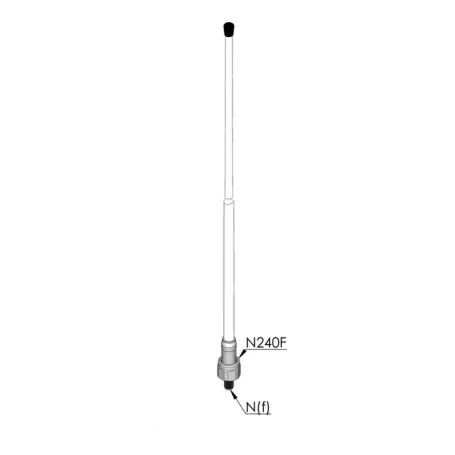
AC Antennas CX4: 3 dB marine gain, 146-162.5 MHz, IP68, 150 W, 1.26 m fibreglass.
The CX4 is a marine VHF antenna from AC Antennas, 0 dBd (2.15 dBi) gain – the conventional “3 dB marine gain” rating – covering 146 to 162.5 MHz. It is a 1.26 m fibreglass whip rated IP68 and 150 W, mounting on a standard 1 inch 14 TPI marine antenna thread.
3 dB marine gain (0 dBd / 2.15 dBi), the lower-gain pattern suited to vessel motion
146-162.5 MHz, covering marine VHF working and distress channels
IP68, 150 W handling, standard 1 inch 14 TPI mount
Mounting / length1 inch 14 TPI marine thread; 1.26 m fibreglass
Description
VHF is a line-of-sight band, so the single biggest determinant of range is how high the
antenna is mounted rather than how much power the radio produces - which is why the antenna
and its siting are treated as a design decision, not a fitting task.
The CX4's own rating is worth explaining rather than just quoting: 0 dBd, equivalent to
2.15 dBi, is what the marine industry calls 3 dB gain. That is deliberately modest. A
higher-gain marine antenna squeezes its radiation pattern flatter, throwing more signal to the
horizon at the cost of coverage directly above and below - which works well on a large, stable
vessel but leaves gaps as a smaller boat rolls and pitches. The CX4's lower-gain pattern is
the one AC Antennas and most fitters recommend for small and medium vessels experiencing real
sea motion, because the wider vertical pattern keeps the signal usable through the roll rather
than losing it at the wrong moment.
It covers 146 to 162.5 MHz, comfortably spanning the marine VHF working and distress
channels either side, handles up to 150 W, and is rated IP68 - sealed against dust and
continuous submersion, not merely splashing. Construction is 1.26 m of fibreglass, mounting on
the standard 1 inch 14 TPI marine antenna thread that most brackets and mounts already
use.
None of that substitutes for the feeder. Coaxial cable loss rises with both frequency and
length, so a long run of undersized cable can absorb a large fraction of the transmitter's
output before it reaches the antenna - and the same loss applies to everything received.
Connectors terminated in a hurry, or left unsealed on an exposed mast, add loss and eventually
let water in. We specify the feeder, its length and its termination together with the antenna
so the installation performs as the antenna's own figures promise.
Features
3 dB marine gain (0 dBd / 2.15 dBi). A deliberately wide vertical pattern
suited to small and medium vessels in real sea motion.
146-162.5 MHz. Covers marine VHF working and distress channels with
margin either side.
IP68. Sealed against dust and continuous submersion, not only
splashing.
150 W handling. Comfortable margin over any marine VHF transmitter.
Standard 1 inch 14 TPI mount. Fits existing marine antenna mounts and
brackets without an adaptor.
Feeder specified with it. Cable type, length and connectors treated as
part of the antenna, because they set the losses the antenna's own rating cannot fix.
Applications
Sourced from FC Marine's AC Antennas CX4 product listings.
Vessel VHF installations. Working and GMDSS sets.
Offshore platforms. Marine coordination and standby vessel
communication.
Port and terminal operations. Shore stations and control
towers.
Refits. Replacing corroded antennas and aged feeder runs, which is
often where lost range is recovered.
Support & Documents
PT Vivo Asia Teknologi Indonesia supplies and services radio and GMDSS equipment as
part of a compliant installation rather than as a boxed item. Our scope typically covers:
Selection against the vessel's or facility's carriage requirements and area of operation.
Installation design: antenna siting, feeder runs, power supplies and battery backup.
Supply, installation, termination and commissioning.
Radio survey support, and coordination with class and flag administration where needed.
Programming, channel plans and licence documentation.
Annual testing, battery replacement and ongoing maintenance.
Approvals, frequencies and electrical details vary by variant and market and are
confirmed against the current manufacturer datasheet at quotation stage. Tell us the
vessel type or site, the flag and the equipment already installed, and we will come back
with the right variant and a full bill of materials.
Use the enquiry button above for a datasheet, a specification or a project quotation.

 1 / 2
1 / 2