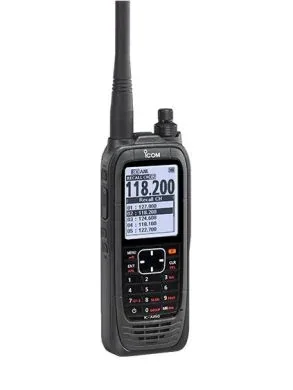
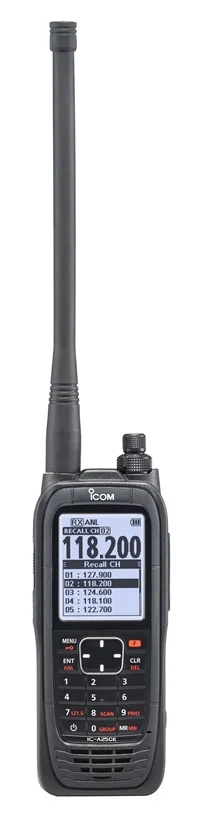
6 W airband handheld: 300 memory channels, 2.3 inch sunlight-readable LCD, IP68 class.
The Icom IC-A25CE outputs 6.0 W PEP / 1.8 W carrier at 7.2 V DC – up from 5/1.5 W on the previous IC-A24E – across 118.000 to 136.992 MHz with 300 memory channels in 15 groups, on 25/8.33 kHz spacing. It weighs 340 g with its BP-288 battery and reads -20 to +55 degrees C.
6.0 W PEP / 1.8 W carrier – up from 5/1.5 W on the IC-A24E it replaces
300 memory channels in 15 groups, 25/8.33 kHz spacing
2.3 inch high-contrast LCD readable in direct sunlight; 340 g with battery
Battery/currentBP-288 7.2 V DC; Tx high under 1.8 A, Rx max under 500 mA
Size/weight/temp58.9 x 148.4 x 31.8 mm; 340 g; -20 to +55 degrees C
Description
Aviation communication does not use the marine band or marine modulation. Aircraft work on
the aviation VHF band using amplitude modulation, which is why helideck communication needs
airband equipment and a marine handheld is of no use for it whatever its quality.
Icom's own figures for this generation are worth reading against the model it replaces: 6.0
W typical PEP and 1.8 W carrier at 7.2 V DC, up from 5 W and 1.5 W on the IC-A24E. That gain in
power matters most at range and in marginal conditions, which is exactly when a helideck
portable earns its keep. The set covers 118.000 to 136.992 MHz - the CE variant is COM-channel
only, while the sibling IC-A25NE adds NAV reception down to 108.000 MHz plus built-in GPS and
Bluetooth - with 300 memory channels across 15 groups and a choice of 25 kHz or 8.33 kHz
spacing, so it fits either the older or the narrower current channel plan.
The 2.3 inch LCD is specified for readability rather than resolution: high contrast, large
graphic screens, and Icom state it ensures good readability under direct sunlight - which on
an open helideck in Indonesian conditions is the display's real test. Frequently used
functions sit directly on an enlarged flat keypad rather than behind menus, for swift operation
in gloves.
Power draw is under 1.8 A on transmit high and under 500 mA on receive at maximum, from a
7.2 V DC BP-288 pack, and the whole unit weighs 340 g fitted with that battery - light enough
to be carried through a full shift without becoming a burden. Operating range is -20 to +55
degrees C, and antenna impedance is the standard 50 ohms. Licensing and channel programming
remain part of supply: aviation frequencies are assigned, and the radio has to be programmed
for the ones the operation is licensed to use.
Features
6.0 W PEP / 1.8 W carrier. A real increase over the 5/1.5 W of the
previous IC-A24E, most useful at range.
300 channels, 15 groups. 25 kHz or 8.33 kHz spacing, fitting either
channel plan.
Sunlight-readable 2.3 inch LCD. High contrast, large characters, tested
against the condition an open helideck actually presents.
340 g with battery. Light enough for a full shift.
-20 to +55 degrees C. Full published operating range.
Under 1.8 A transmit / 500 mA receive. From the 7.2 V DC BP-288
pack.
Applications
Sourced from Icom's own IC-A25NE/CE product page and specification tables.
Offshore helidecks. Platforms, FPSOs and drilling units.
Onshore helipads. Base and hospital pads.
Helideck teams. HLO and HDA use during movements.
Backup provision. Where the fixed airband system needs a portable
fallback.
Support & Documents
PT Vivo Asia Teknologi Indonesia supplies and services radio and GMDSS equipment as
part of a compliant installation rather than as a boxed item. Our scope typically covers:
Selection against the vessel's or facility's carriage requirements and area of operation.
Installation design: antenna siting, feeder runs, power supplies and battery backup.
Supply, installation, termination and commissioning.
Radio survey support, and coordination with class and flag administration where needed.
Programming, channel plans and licence documentation.
Annual testing, battery replacement and ongoing maintenance.
Approvals, frequencies and electrical details vary by variant and market and are
confirmed against the current manufacturer datasheet at quotation stage. Tell us the
vessel type or site, the flag and the equipment already installed, and we will come back
with the right variant and a full bill of materials.
Use the enquiry button above for a datasheet, a specification or a project quotation.

 1 / 2
1 / 2