A hotline telephone is a telephone with the dialling removed. You lift it, or press the one
button, and it connects to a predetermined destination - the control room, the operator, the
help desk. That constraint is the entire point. In an emergency the person using it may never
have used it before, may not know the number, and may not be in a state to look one up. Taking
the decision away makes it work.
Zenitel offer this in four variants, and the choice is worth making deliberately: full
keyboard or hotline with no keyboard, each available with or without a door. The keyboard
version is a general-purpose industrial telephone; the hotline version is the one for public
help points and emergency positions. The door adds protection where the unit is exposed or
liable to be interfered with.
Construction is where the "heavy duty" is real rather than a label. The casing is 5 mm
aluminium with stainless steel components, water and dust resistant to IP66, with a coiled
rubber cord and a magnetic reed hook-switch that Zenitel specify precisely because it has
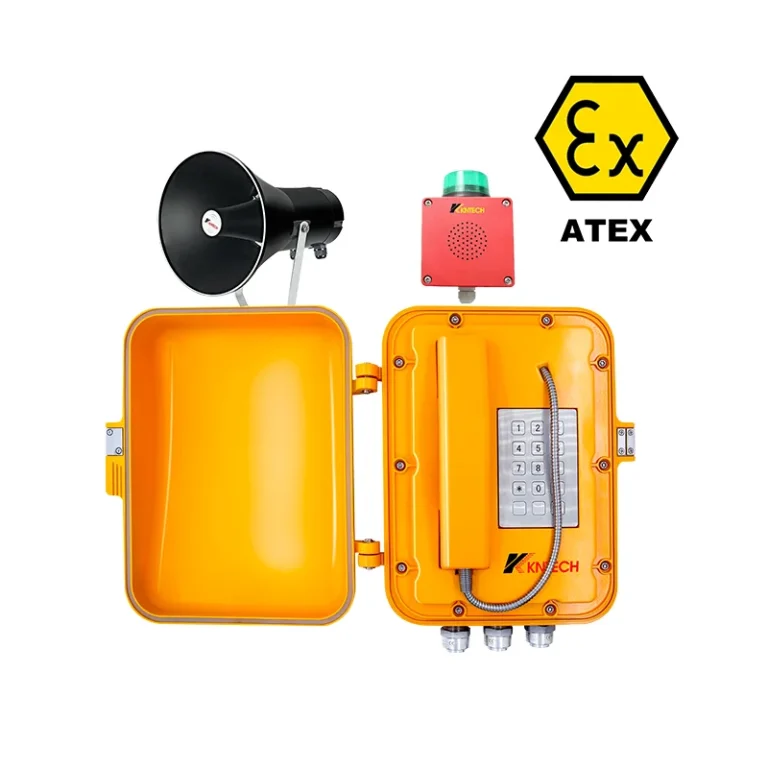
minimal wear and tear. This is the yellow variant, which is the colour convention for
emergency and help point telephones - it should be found without being looked for. Zenitel are
explicit that this is for rough environments and for indoor use, which includes roads,
tunnels and ships.
On the network side it is a full IP device rather than an analogue set with a converter. It
supports SIP and Zenitel's CCoIP, plus ONVIF, and connects to ICX-AlphaCom, IC-EDGE and
standard iPBXs. HD voice is supported, and there is an integrated data switch with advanced
networking and security functions. It runs from PoE or from local power, so a position without
a spare supply is not a problem.
Two features matter for anything installed as safety equipment. There is an option for GSM
cellular connectivity, which means a help point can work where there is no cable to it - a
roadside position or a remote gate. And it has advanced supervision functions, so the system
knows the telephone is alive. An emergency telephone that has quietly failed is worse than no
telephone at all, because people rely on it being there; supervision is what turns that from
a hope into a monitored state.