Wi-Fi 6 is not primarily about peak speed. Its important change is OFDMA, which lets one
transmission carry data for several clients at once by dividing the channel into resource
units. Older Wi-Fi served clients strictly in turn, so a dense area full of devices sending
small amounts of data spent most of its airtime on overhead. OFDMA addresses exactly that, which
is why Wi-Fi 6 matters most in busy areas rather than on a fast laptop. MU-MIMO does the
complementary job in the spatial domain, serving multiple clients simultaneously on separate
streams.
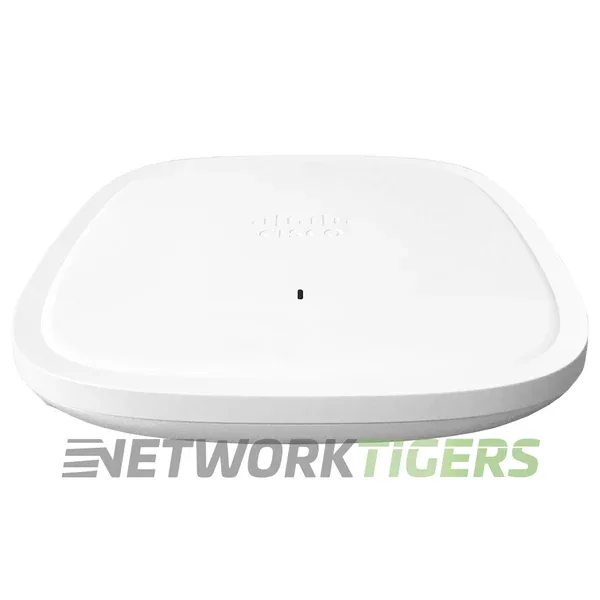
The 9120AX's radio arrangement is the part worth understanding, because it is unusual and it
determines what the access point can do. There are four radios. One is a 4x4 XOR radio that can
be assigned to either 2.4 GHz or 5 GHz - so in a dense environment where 2.4 GHz is congested and
of little value, it can be switched to 5 GHz and the access point becomes a dual 5 GHz device
with twice the capacity in the useful band. Alongside it is a dedicated single-band 4x4 radio
for 5 GHz. A third radio covers 2.4 GHz and can be used with a BLE device, which is how
Bluetooth-based location and IoT services are delivered. The fourth is an auxiliary radio
covering both 2.4 and 5 GHz.
That auxiliary radio is the quiet advantage. On a conventional access point, scanning the
spectrum for interference, rogue devices and channel conditions has to be done by a serving
radio, which means taking it briefly off client duty. A dedicated auxiliary radio monitors
continuously without interrupting service, so interference detection and analytics are always
running rather than sampled.
The I in 9120AXI means internal antennas, and the antenna complement follows the radios: four
integrated internal dual-band antennas, four single-band 5 GHz antennas used when the access
point is configured for dual 5 GHz mode, one 2.4 GHz antenna for IoT, and one dual-band antenna
for the auxiliary radio. Internal antennas are the right choice for an office, a corridor or an
accommodation block - nothing protrudes, nothing gets knocked, and the coverage pattern is
predictable. Where a warehouse or a high-ceiling space needs directional coverage, the external
antenna model is the one to specify instead.
Two practical points for design. Multigigabit support on the uplink exists because a Wi-Fi 6
access point with two 4x4 radios can exceed one gigabit of real traffic, so a plain gigabit
switch port becomes the bottleneck - the switch specification and the access point specification
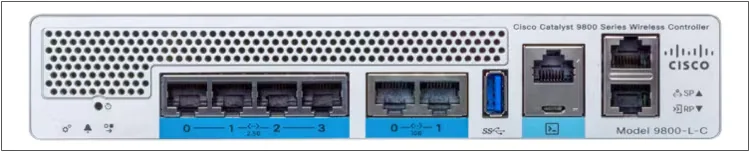
have to be decided together. And these are controller-based access points, so a wireless
controller such as the Catalyst 9800-L is part of the same design rather than an
afterthought.

 1 / 3
1 / 3