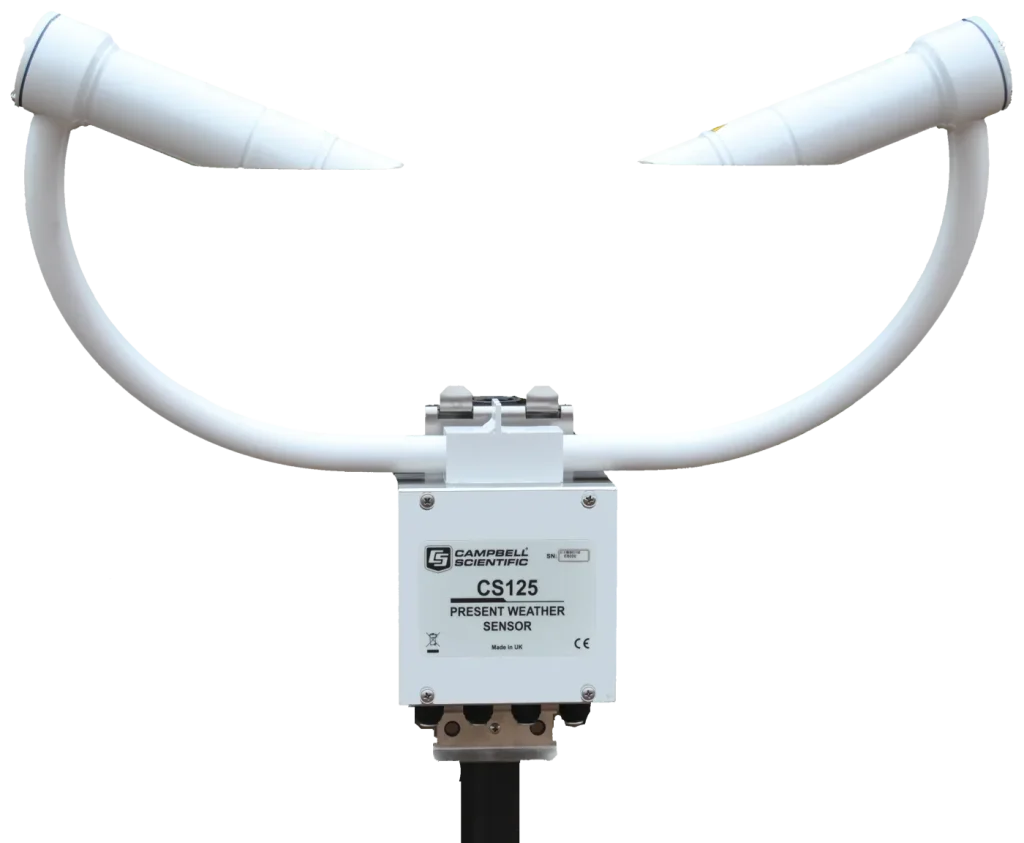
Campbell CS125 Present Weather and Visibility Sensor
Forward-scatter sensor reporting visibility and 57 SYNOP present weather codes.
The Campbell CS125 is an infrared forward-scatter visibility and present weather sensor. It measures Meteorological Optical Range using a 42 degree scatter angle and identifies the weather type from particle scattering, fall speed and temperature, reporting 57 SYNOP codes with METAR and NWS equivalents.
57 SYNOP present weather codes, with METAR and NWS equivalents
42 degree forward scatter, accurate M.O.R. for fog and snow
ReportsM.O.R. visibility and 57 SYNOP present weather codes
IdentificationScattering properties, fall speed and temperature
HeatersLow-power dew prevention plus anti-icing hood heaters
Connection5 m attached cable with DB9; pole 32-52.5 mm
Description
Visibility is the other limiting weather parameter for flight operations, and on a marine or
industrial site it is also an operational one - loading, crane work and vessel movements all
have visibility limits. Reporting it by eye is unreliable and, at night or on an unmanned
structure, impossible. That is what a forward-scatter sensor replaces.
The CS125 measures visibility by shining infrared light across a short path and measuring
how much is scattered forward at a 42 degree angle. Campbell are specific that this angle gives
accurate estimates of Meteorological Optical Range for fog and snow, and the choice of angle is
the substance of the design: scattering behaviour varies with particle size, and 42 degrees is
where fog droplets and snow crystals both produce a signal that maps reliably onto M.O.R.
What lifts it above a plain visibility meter is present weather identification. The sensor
identifies precipitation particles from their scattering properties and their fall speeds, and
combines that with a temperature measurement to determine what the weather actually is. Fall
speed distinguishes drizzle from rain; temperature distinguishes rain from snow at the margin.
From that it reports 57 SYNOP present weather codes with the associated METAR and NWS codes,
plus hail detection and past weather codes - so the output is an aviation and meteorological
report rather than a number needing interpretation.
The heating arrangement deserves attention because it is where cheaper sensors fail. The
CS125 has low-power dew prevention heaters and, as standard, higher-power anti-icing heaters for
the hoods. Both are automatically controlled to ensure operation in all weather, and either can
be disabled individually to save power. That last point matters on a solar or
battery-constrained installation, where anti-icing may be pointless in the tropics and turning
it off recovers a meaningful part of the power budget.
Self-monitoring is the feature that makes an unattended installation trustworthy. The sensor
continuously monitors its own status and reports internal faults and contamination or blockage of
its lenses - which is the failure that would otherwise be indistinguishable from genuine fog. It
also provides two user-configurable alarm outputs able to drive audible or visual alarms through
solid-state relays, so a visibility threshold can trigger something directly without a
controller in between. Campbell note the CS125 is certified by Deutscher Wetterdienst as
suitable for controlling wind turbine obstruction light systems under the German administrative
rules for identifying aircraft obstructions - an independent certification for exactly that
automatic control duty. It ships with a 5 m cable and DB9 connector and mounts on a vertical
pole of 32 to 52.5 mm diameter.
Features
57 SYNOP codes. With associated METAR and NWS present weather codes, plus
hail and past weather.
42 degree forward scatter. Chosen to give accurate M.O.R. for both fog and
snow.
Identifies weather, not just visibility. Scattering properties and fall
speeds combined with temperature.
Two heater systems. Low-power dew prevention plus standard anti-icing hood
heaters, automatically controlled and individually disableable.
Reports its own contamination. Lens blockage and internal faults flagged,
so dirt is not mistaken for fog.
Two configurable alarm outputs. Drive audible or visual alarms through
solid-state relays without an intermediate controller.
DWD certified. Approved for controlling wind turbine obstruction light
systems under the German obstruction identification rules.
Simple installation. 5 m attached cable with DB9, on a 32-52.5 mm
pole.
Applications
Visibility and weather type wherever operations have limits.
Helideck met stations. Visibility for approach decisions.
Airports and heliports. Automatic METAR present weather reporting.
Offshore platforms. Fog detection for navaid and operational
control.
Wind farms. Driving obstruction light intensity, the duty DWD certified it
for.
Roads and bridges. Fog warning systems, one of Campbell's stated
applications.
Ports and terminals. Visibility limits for crane and vessel
movements.
Support & Documents
PT Vivo Asia Teknologi Indonesia supplies weather and helideck monitoring as an
integrated, commissioned system rather than as individual instruments. Our scope typically
covers:
Selection against CAP 437, the relevant national requirement or your operator's standard.
Sensor siting to avoid the structure's own turbulence, exhaust and heat sources.
Signal, power and hazardous-area design across the deck and up to the control room.
Supply, installation, termination and commissioning.
Integration with the helideck monitoring system, status lighting and reporting outputs.
Calibration, periodic verification and ongoing maintenance.
Ranges, accuracies, approvals and electrical details vary by variant and are confirmed
against the current manufacturer datasheet at quotation stage. Tell us the structure, the
standard you are working to and the parameters you must report, and we will come back with
a system design and a full bill of materials.
Use the enquiry button above for a datasheet, a specification or a project quotation.