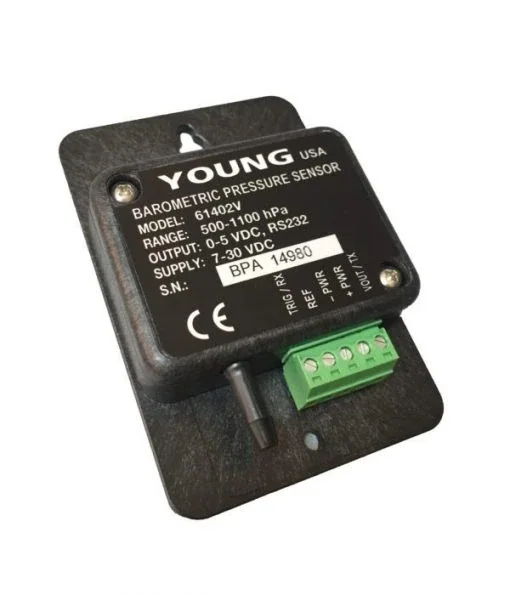
Barometric pressure from 500 to 1100 hPa to 0.2 hPa accuracy, with 4-20 mA, RS-232, RS-485 and SDI-12.
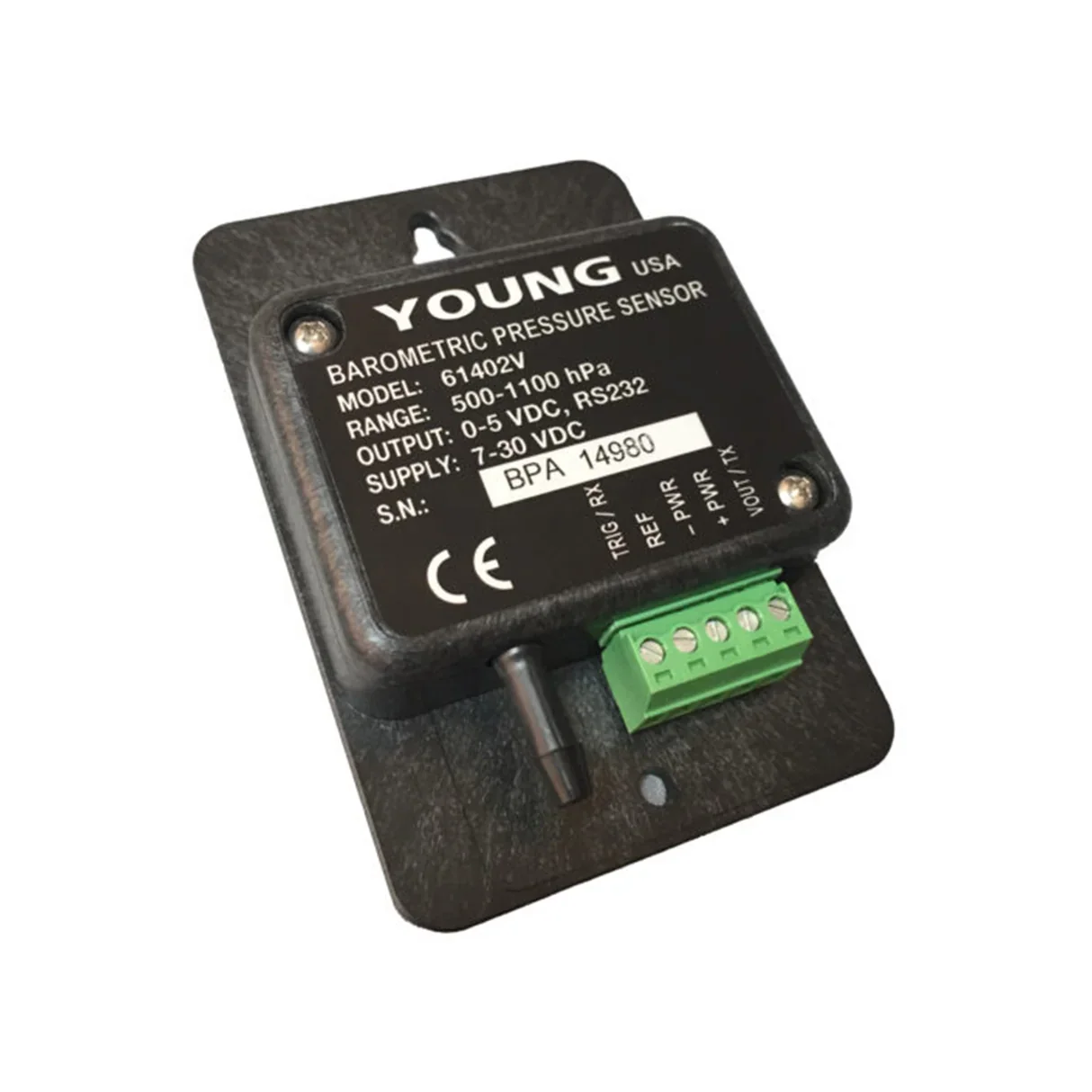
YOUNG barometric pressure sensors combine high accuracy with low power consumption over a wide range of pressures, 500 to 1100 hPa, and temperatures. The 61402L offers 4-20 mA, RS-232, RS-485 and SDI-12 outputs from one instrument, accurate to 0.2 hPa at 25 C and 0.3 hPa across -40 to +60 C.
500 to 1100 hPa, covering sea level to high altitude
Four output types: 4-20 mA, RS-232, RS-485 and SDI-12
0.2 hPa accuracy at 25 C; 0.3 hPa across -40 to +60 C
Range500 to 1100 hPa (span programmable within it)
Accuracy0.2 hPa at 25 C; 0.3 hPa from -40 to +60 C
Outputs4-20 mA, RS-232, RS-485, SDI-12
ConnectorPlug-in screw terminal
UseMet stations, aviation and marine reporting
Description
Barometric pressure is the least visible measurement on a weather station and one of the
most consequential. It is the basis of the altimeter setting an aircraft flies on, so an error
in the reported pressure becomes an error in the aircraft's indicated height - which on an
offshore approach in poor visibility is the measurement least tolerant of being wrong. It is
also the primary short-term forecasting signal: the rate at which pressure is falling tells you
more about the next twelve hours than any single reading.
The 61402L covers 500 to 1100 hPa. That range is wider than a coastal site needs, and
deliberately so - it spans from well below any sea-level low pressure system to above the
highest recorded anticyclone, and the lower end accommodates installation at altitude. YOUNG
pair that with high accuracy and low power consumption over a wide temperature range, and the
low power figure is the one that matters on a remote or solar-powered station where the
barometer runs continuously.
The output options are unusually generous for one instrument, and they are the reason this
particular model gets specified: 4-20 mA, RS-232, RS-485 and SDI-12 are all available. That
covers essentially every way a met sensor gets connected. The current loop suits a long run into
a PLC or an analogue input. RS-232 is the direct connection to a single logger or display.
RS-485 is the multi-drop bus where several instruments share one cable back to the data
acquisition system, which on a platform saves a great deal of cable. SDI-12 is the low-power
serial standard used across environmental monitoring, which lets the sensor share a bus with
other SDI-12 instruments and be interrogated by address.
Installation is simpler than for the other met sensors, since pressure does not need
exposure - the sensor can live inside an enclosure, which is why it usually outlasts everything
on the mast. The one requirement is a static pressure port that is not affected by wind: a
pressure tapping in a windy position reads dynamic pressure as well as static, and the error
appears exactly when the weather is worth measuring. Where the reading feeds an altimeter
setting, the sensor's height above the reference datum has to be recorded and corrected for,
which is a commissioning matter rather than a hardware one.
Features
500 to 1100 hPa. Wider than any sea-level weather, and workable at
altitude.
Four outputs in one instrument. 4-20 mA, RS-232, RS-485 and SDI-12, so it
fits any acquisition scheme.
RS-485 multi-drop. Several instruments on one cable, which saves
substantial cabling on a platform.
SDI-12 support. Shares a low-power bus with other environmental sensors,
addressed individually.
Low power consumption. Suits remote and solar-powered stations running
continuously.
Protected installation. Needs no weather exposure, so it typically
outlives the mast-mounted sensors.
Feeds altimeter settings. With sensor height above datum recorded and
corrected at commissioning.
Applications
Pressure measurement anywhere weather is reported or flown on.
Helideck met stations. Altimeter setting for inbound aircraft.
Offshore platform weather systems. Pressure trend for operational
forecasting.
Airports and helipads. QNH and QFE reporting.
Marine and port stations. Routine synoptic reporting.
Remote automatic weather stations. Where low power consumption
decides the design.
Multi-sensor installations. Sharing an RS-485 or SDI-12 bus with other
instruments.
Support & Documents
PT Vivo Asia Teknologi Indonesia supplies weather and helideck monitoring as an
integrated, commissioned system rather than as individual instruments. Our scope typically
covers:
Selection against CAP 437, the relevant national requirement or your operator's standard.
Sensor siting to avoid the structure's own turbulence, exhaust and heat sources.
Signal, power and hazardous-area design across the deck and up to the control room.
Supply, installation, termination and commissioning.
Integration with the helideck monitoring system, status lighting and reporting outputs.
Calibration, periodic verification and ongoing maintenance.
Ranges, accuracies, approvals and electrical details vary by variant and are confirmed
against the current manufacturer datasheet at quotation stage. Tell us the structure, the
standard you are working to and the parameters you must report, and we will come back with
a system design and a full bill of materials.
Use the enquiry button above for a datasheet, a specification or a project quotation.

 1 / 2
1 / 2