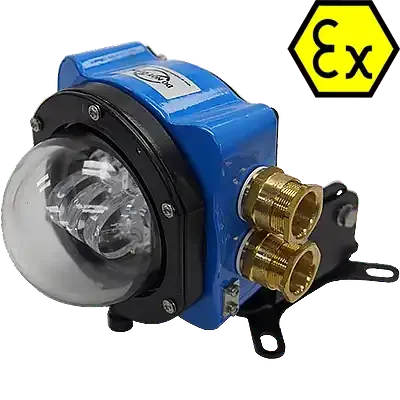
5000 cd CAP437 floodlight for hazardous areas, with a 15,000 cd version available.
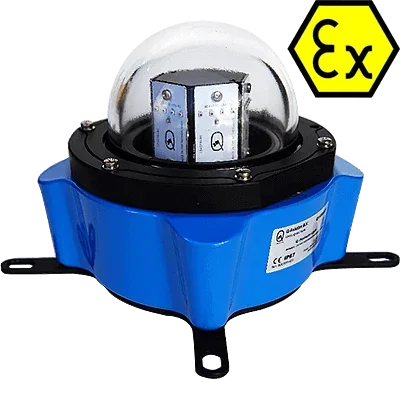
The Q-Explosion Proof Floodlight is a CAP437 compliant 5000 candela floodlight for hazardous areas, part of Q-Aviation’s LED helideck lighting range. A high intensity version rated 15,000 candela is also available where more output is required.
5000 cd, CAP437 compliant, for hazardous areas
High intensity 15,000 cd version available
LED, from the same range as the rest of the deck lighting
Floodlights do the job the marking lights cannot: they light the deck surface itself, so
that once an aircraft is down, people can work. Passengers disembark, baggage and freight are
handled, refuelling happens, and none of that is possible by the light of a perimeter outline.
The floodlights are also what let the crew see the deck condition - ice, spillage, loose
equipment - before an aircraft arrives.
Q-Aviation's explosion-proof floodlight is a CAP437 compliant 5000 candela unit for hazardous
areas, with a 15,000 candela high-intensity version available. Having both in the range is the
useful part: output requirement scales with deck size and mounting height, so a large deck lit
from a high mounting needs the high-intensity unit while a smaller deck would be over-lit by
it.
Over-lighting is a genuine hazard rather than a waste, and it is why floodlights are
controlled separately from the marking lights. A pilot approaching at night has dark-adapted
vision, and a deck lit to daylight levels destroys it - along with the ability to see the
perimeter and TD/PM lighting the approach is actually flown to. Standard practice is that the
floodlights are off or low during the approach and brought up once the aircraft is down, which
is exactly why Q-Aviation's control systems put them on their own switched group.
Aiming is the other half of getting this right, and it is a design decision. Floodlights
have to illuminate the working area without shining into the approach path or into the
pilot's eyes, which usually means mounting them at the deck edge and directing them inward and
downward. A floodlight that has been re-aimed by someone who found the deck too dim can quietly
make the deck unusable at night.
The explosion-proof construction and LED source follow the rest of the range. LED matters
particularly for floodlights because they are the highest-power fittings on the deck: efficiency
determines the load the control system and the supply have to carry, and instant full output
means there is no warm-up delay between the decision to light the deck and the deck being
lit.
Features
5000 candela, CAP437 compliant. Q-Aviation's published figure for the
standard hazardous-area unit.
15,000 candela version available. For larger decks and higher mounting
positions.
Separately switched. Kept on its own control group so the deck is not
flooded during an approach.
LED. Efficiency matters most on the highest-power fittings, and there is
no warm-up delay.
Explosion proof. Certified for hazardous area helidecks.
Aimed by design. Positioned to light the working area without entering the
approach path.
Part of one range. Matches the perimeter, TD/PM, status and obstruction
lighting.
Applications
Deck illumination for everything that happens after landing.
Offshore platform helidecks. Passenger and freight handling at
night.
FPSOs and drillships. Round-the-clock crew change operations.
Vessel helidecks. Deck work in darkness.
Refuelling positions. Where adequate task lighting is a safety
requirement.
Large decks. Where the 15,000 cd version suits the size and mounting
height.
Pre-arrival deck inspection. Checking surface condition before an aircraft
is accepted.
Support & Documents
PT Vivo Asia Teknologi Indonesia supplies weather and helideck monitoring as an
integrated, commissioned system rather than as individual instruments. Our scope typically
covers:
Selection against CAP 437, the relevant national requirement or your operator's standard.
Sensor siting to avoid the structure's own turbulence, exhaust and heat sources.
Signal, power and hazardous-area design across the deck and up to the control room.
Supply, installation, termination and commissioning.
Integration with the helideck monitoring system, status lighting and reporting outputs.
Calibration, periodic verification and ongoing maintenance.
Ranges, accuracies, approvals and electrical details vary by variant and are confirmed
against the current manufacturer datasheet at quotation stage. Tell us the structure, the
standard you are working to and the parameters you must report, and we will come back with
a system design and a full bill of materials.
Use the enquiry button above for a datasheet, a specification or a project quotation.