826 cd flashing at 120 per minute: the light that tells a helicopter not to land.
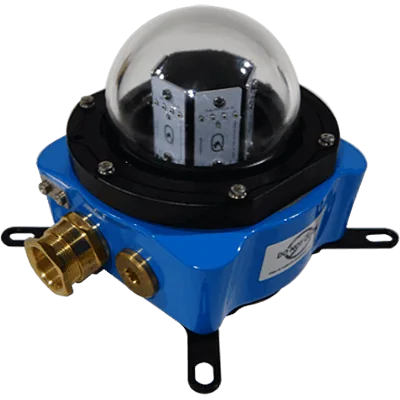
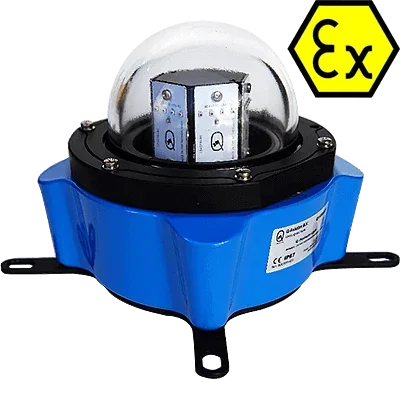
The Q-Explosion Proof Status Light is a CAP437 compliant 826 candela light flashing at 120 per minute, for offshore facilities. It is the visual warning that a condition exists which may be hazardous to the helicopter or its occupants, and it operates from a dedicated status light controller.
826 cd at 120 flashes per minute, CAP437 compliant
The visual warning that landing is prohibited
Requires the Q14RI03C controller, or the WMX control system
The status light is the one piece of helideck equipment whose job is to say no. Q-Aviation
put the requirement plainly: a visual warning system should be installed if a condition can
exist on an installation which may be hazardous for the helicopter or its occupants. Gas
release, a process upset, an emergency in progress - the pilot needs to know before committing
to an approach, and needs to know it in a way that does not depend on a radio call being made,
heard and understood.
That is why the specification is what it is. At 826 candela flashing 120 times a minute, this
is not a light you interpret; it is a light that resolves any ambiguity about whether the deck
is available. Both figures are CAP437 requirements rather than design choices, and the flash
rate is generated by the controller rather than by the light itself, which is what keeps
multiple lights on a deck flashing in step.
The architecture is worth understanding before ordering, because this light does not work
alone. Q-Aviation are explicit that both status lights must be connected to the status light
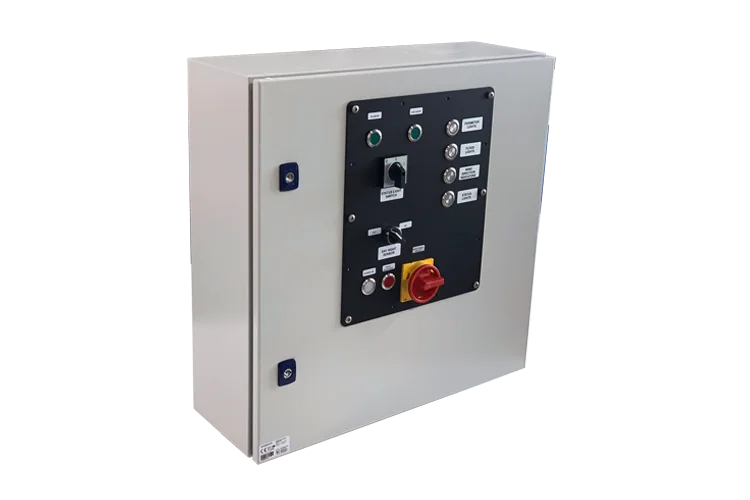
controller, and that the controller - order code Q14RI03C - is a separate product. Where a
complete helideck package is supplied, that controller can instead be built into the Q-Control
WMX series control system, which is the tidier arrangement and the one to specify if the control
system is being bought at the same time. Buying the lights without the controller is the
mistake to avoid.
What the controller is connected to on its input side is the part that determines whether the
system is genuinely useful. Q-Aviation offer a gas sensor input and remotely controllable
intensity on the status light system, and the gas input is the significant one: it lets a gas
detection alarm drive the status light directly, so a release prohibits landing without anyone
having to remember to press anything. Remote intensity control matters because a light sized to
be unmistakable by day is punishing at night.
Construction matches the rest of the Ex range - aluminium powder coated in RAL5015 with
borosilicate glass, external earthing provision up to 4 mm squared or AWG 12, and compliance
with ICAO Annex 14 and CAP437. The external earth terminal is not a detail to skip on
explosion-proof equipment: bonding is part of what makes the certification valid in
service.
Features
826 cd at 120 FPM. CAP437 figures, sized so the prohibition cannot be
misread.
Flash rate from the controller. Which is what keeps both deck lights
flashing in step.
Gas sensor input. Lets gas detection prohibit landing automatically,
without anyone having to act.
Remote intensity control. Different levels for day and night, changed from
the control room.
Controller required. Q14RI03C as a separate product, or built into the
Q-Control WMX series with a full package.
Explosion proof. Aluminium powder coated RAL5015 with borosilicate
glass.
External earthing up to 4 mm2 / AWG 12. Bonding provision that keeps the
certification valid in service.
ICAO Annex 14 and CAP437. Compliant as part of the certified helideck
lighting scheme.
Applications
Required wherever a hazardous condition could exist while an aircraft is inbound.
Offshore oil and gas platforms. Gas release or process upset prohibiting
landing.
FPSOs and drillships. Cargo and drilling operations affecting deck
availability.
Semi-submersibles and jack-ups. Well operations in progress.
Vessel helidecks. Deck operations conflicting with flight
operations.
LNG and onshore terminals. Helipads within a classified area.
Facilities with gas detection. Where the detection system drives the
status light directly.
Support & Documents
PT Vivo Asia Teknologi Indonesia supplies weather and helideck monitoring as an
integrated, commissioned system rather than as individual instruments. Our scope typically
covers:
Selection against CAP 437, the relevant national requirement or your operator's standard.
Sensor siting to avoid the structure's own turbulence, exhaust and heat sources.
Signal, power and hazardous-area design across the deck and up to the control room.
Supply, installation, termination and commissioning.
Integration with the helideck monitoring system, status lighting and reporting outputs.
Calibration, periodic verification and ongoing maintenance.
Ranges, accuracies, approvals and electrical details vary by variant and are confirmed
against the current manufacturer datasheet at quotation stage. Tell us the structure, the
standard you are working to and the parameters you must report, and we will come back with
a system design and a full bill of materials.
Use the enquiry button above for a datasheet, a specification or a project quotation.
 1 / 2
1 / 2