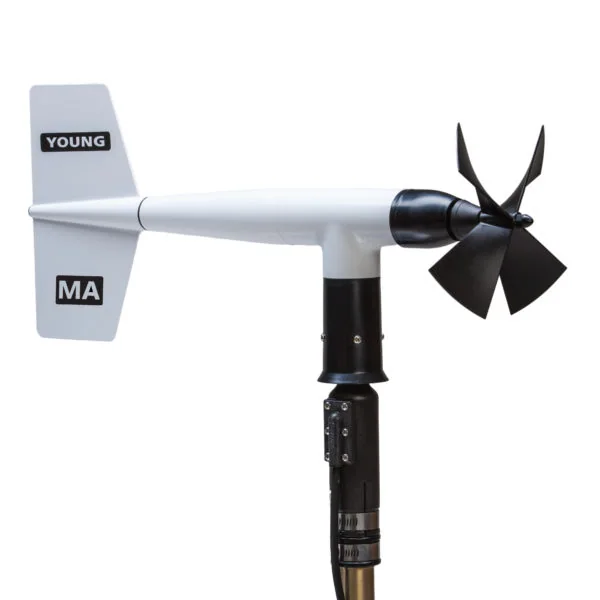
The marine Wind Monitor: ceramic bearings, 0 to 100 m/s, accurate to 0.3 m/s.
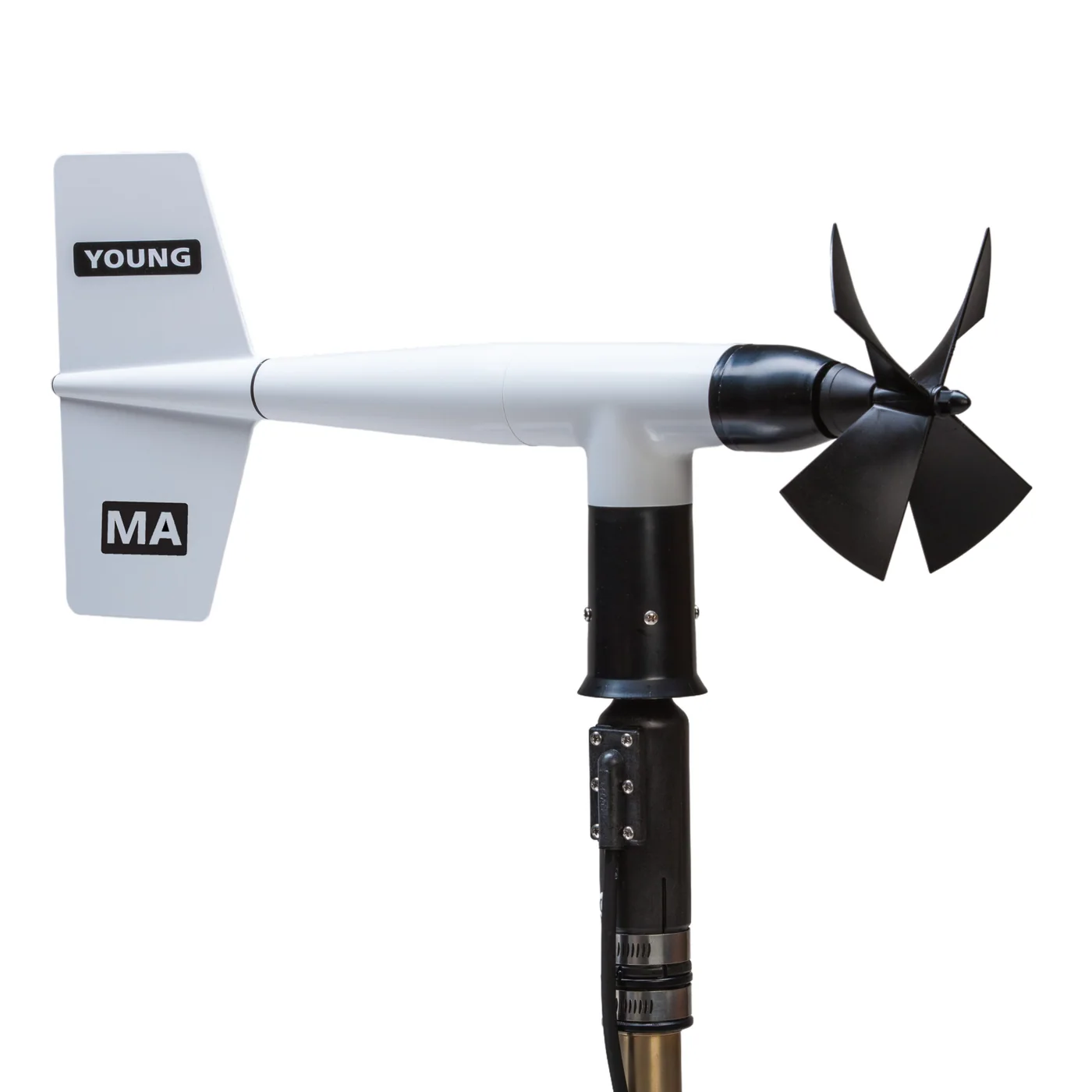
The YOUNG Model 05106 Wind Monitor-MA measures horizontal wind speed and direction. It uses corrosion resistant ceramic bearings and ruggedised vertical components for the marine environment, reads 0 to 100 m/s to within 0.3 m/s or 1 percent, and gives direction to 3 degrees.
Ceramic bearings and ruggedised components for marine use
0 to 100 m/s, accurate to 0.3 m/s or 1 percent of reading
Cable terminated in a sealed capsule inside the sensor
AccuracySpeed 0.3 m/s or 1% of reading; direction 3 degrees
ThresholdPropeller 1.0 m/s, vane 1.0 m/s
OutputSpeed as AC sine wave; direction by precision potentiometer
MountingStandard 1-inch IPS pipe
Description
The 05106 is the marine version of R.M. Young's Wind Monitor, and the Wind Monitor is
probably the most widely deployed propeller-vane anemometer in professional meteorology. Its
design is old enough to be thoroughly characterised, which is exactly what you want in a
reference instrument: the response of this sensor to a gust is published, repeatable and
comparable with decades of data taken by the same instrument.
What separates the marine model from the standard 05103 is corrosion. YOUNG describe it as
similar in operation but using long-lasting, corrosion resistant ceramic bearings and
ruggedised vertical components for the additional rigors of the marine environment. Bearings
are the whole argument. A propeller anemometer's accuracy at low wind speed depends entirely on
how freely its bearings turn, and salt air degrades ordinary bearings until the sensor stops
responding to light winds - reporting calm when there is a breeze, which is the failure mode
least likely to be noticed and most likely to matter.
The published figures are a range of 0 to 100 m/s - 224 mph, well beyond any wind that will
be survived by the structure it is mounted on - with accuracy of 0.3 m/s or 1 percent of
reading, and direction to 3 degrees over 360 degrees mechanical and 355 degrees electrical with
a 5 degree open sector. Starting thresholds are 1.0 m/s for both propeller and vane. The dynamic
response figures are the ones a serious user cares about: a propeller distance constant of 2.7 m
for 63 percent recovery, a vane delay distance of 1.3 m for 50 percent recovery, a damping ratio
of 0.3 and a damped natural wavelength of 7.4 m. Those numbers describe how faithfully the
sensor follows a changing wind, which is what determines whether a reported gust is real.
The outputs are deliberately simple and robust. Wind speed comes out as an AC sine wave whose
frequency is proportional to speed, and direction as the resistance of a precision
potentiometer. Neither is a digital protocol that can go out of support, and both can be read by
almost any data logger or helideck monitoring system - which is why this sensor appears in
installations of every vintage.
Two practical details. The cable is attached inside a sealed capsule internal to the sensor,
with different lengths available, which removes the exposed connector that is usually the first
thing to corrode on a masthead instrument. And it mounts on standard 1-inch IPS pipe, so the
mechanical installation needs no proprietary hardware. Orientation at installation matters -
direction is meaningless if the sensor is not aligned - and YOUNG supply a mounting orientation
ring for the purpose.
Features
Ceramic bearings. Corrosion resistant, which is what keeps low-wind
response alive in salt air.
Ruggedised vertical components. Built for the additional rigors of the
marine environment.
0 to 100 m/s. Far beyond any survivable wind, so the instrument is never
the limiting factor.
0.3 m/s or 1 percent, 3 degrees. Reference-grade accuracy in speed and
direction.
Published dynamic response. Distance constant, delay distance and damping
ratio all stated, so gust data can be trusted.
Protocol-free outputs. AC sine wave for speed and a potentiometer for
direction - readable by any logger, now or in twenty years.
Sealed internal cable capsule. No exposed connector to corrode at the
masthead.
Standard 1-inch IPS mounting. No proprietary hardware, with an
orientation ring supplied.
Offshore platforms and FPSOs. Met station wind reference.
Vessels. Relative and true wind measurement.
Ports, terminals and jetties. Wind limits for crane and berthing
operations.
Coastal met stations. Where marine air affects inland
instruments too.
Long-record sites. Where continuity with existing Wind Monitor data
matters.
Support & Documents
PT Vivo Asia Teknologi Indonesia supplies weather and helideck monitoring as an
integrated, commissioned system rather than as individual instruments. Our scope typically
covers:
Selection against CAP 437, the relevant national requirement or your operator's standard.
Sensor siting to avoid the structure's own turbulence, exhaust and heat sources.
Signal, power and hazardous-area design across the deck and up to the control room.
Supply, installation, termination and commissioning.
Integration with the helideck monitoring system, status lighting and reporting outputs.
Calibration, periodic verification and ongoing maintenance.
Ranges, accuracies, approvals and electrical details vary by variant and are confirmed
against the current manufacturer datasheet at quotation stage. Tell us the structure, the
standard you are working to and the parameters you must report, and we will come back with
a system design and a full bill of materials.
Use the enquiry button above for a datasheet, a specification or a project quotation.

 1 / 2
1 / 2