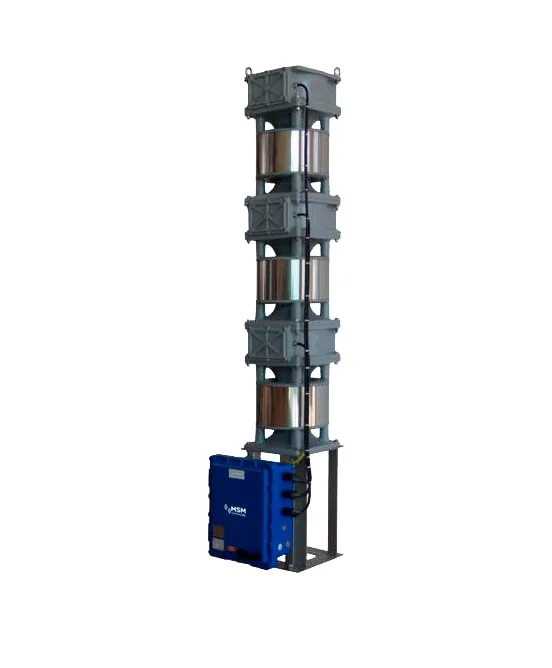
An antenna tuning unit sits between the transmitter and the antenna and makes the two match.
At the low and medium frequencies an NDB uses, an antenna is electrically short compared with
the wavelength, so it presents a largely capacitive impedance rather than the resistive load a
transmitter wants to drive. The ATU cancels that with inductance and transforms what remains
into something the transmitter can deliver power into. Without it, most of the power never
leaves the antenna.
The interesting engineering here is that the match does not stay put. An NDB antenna's
impedance moves with its environment - Nautel name the two culprits directly: salt building up
on the antenna insulators, and changes in ground plane resistance. Offshore, both happen
continuously. A unit tuned perfectly at commissioning drifts, the antenna current falls, and
coverage shrinks without anything appearing to be broken.
The Vector system's answer is automatic capacitance tuning, and the way it is implemented is
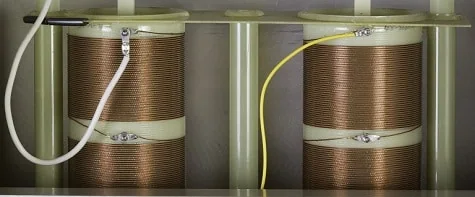
worth noting. The capacitive part of the antenna impedance is matched using dual astatically
wound loading coils. Winding the pair astatically means their external fields largely cancel,
so the assembly produces a lower field than a single coil doing the same job - and a lower
field means fewer eddy currents induced in surrounding structure, which on a steel platform is
exactly where losses and unpredictability come from. It is a design choice that pays off
specifically in the environment these are used in.
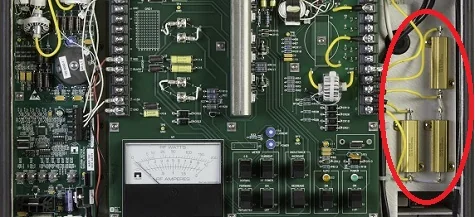
Alongside the automatic tuning there is a standard adjustable series resistor, which sets
the trade-off between antenna efficiency and bandwidth. That trade-off is real and has to be
chosen deliberately: a high-Q, narrow-bandwidth match is more efficient but less tolerant of
drift and of the sidebands the keyed identification signal produces. Having it adjustable
means the installation can be tuned to the site rather than to a nominal design.
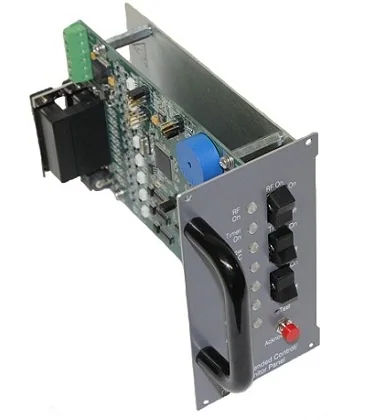
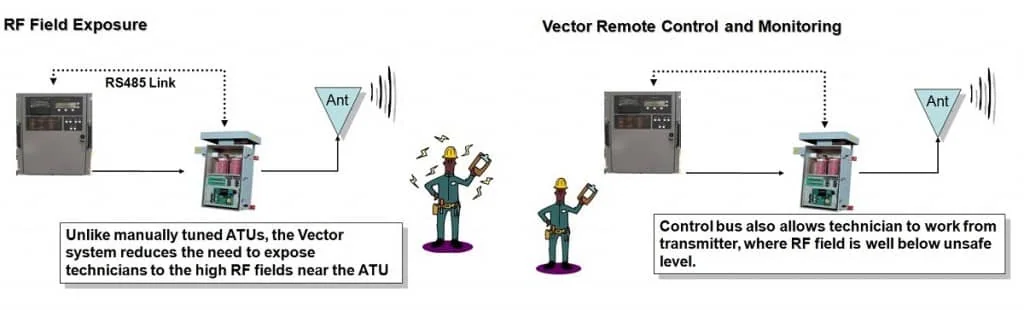
Two practical points. Remote control and monitoring of the ATU is provided specifically to
limit worker exposure to strong RF fields, in keeping with Safety Code 6 and IEEE
C95.1-1999 - an ATU at the base of a live antenna is not somewhere to stand. And the cabinet
enclosure is designed to meet IP66, with an optional sunshield, because this is equipment that
lives outdoors on a platform for decades. The unit is compliant with the specifications and
recommendations of ICAO Annex 10, Volume 1, Part 1, Section 3.4.