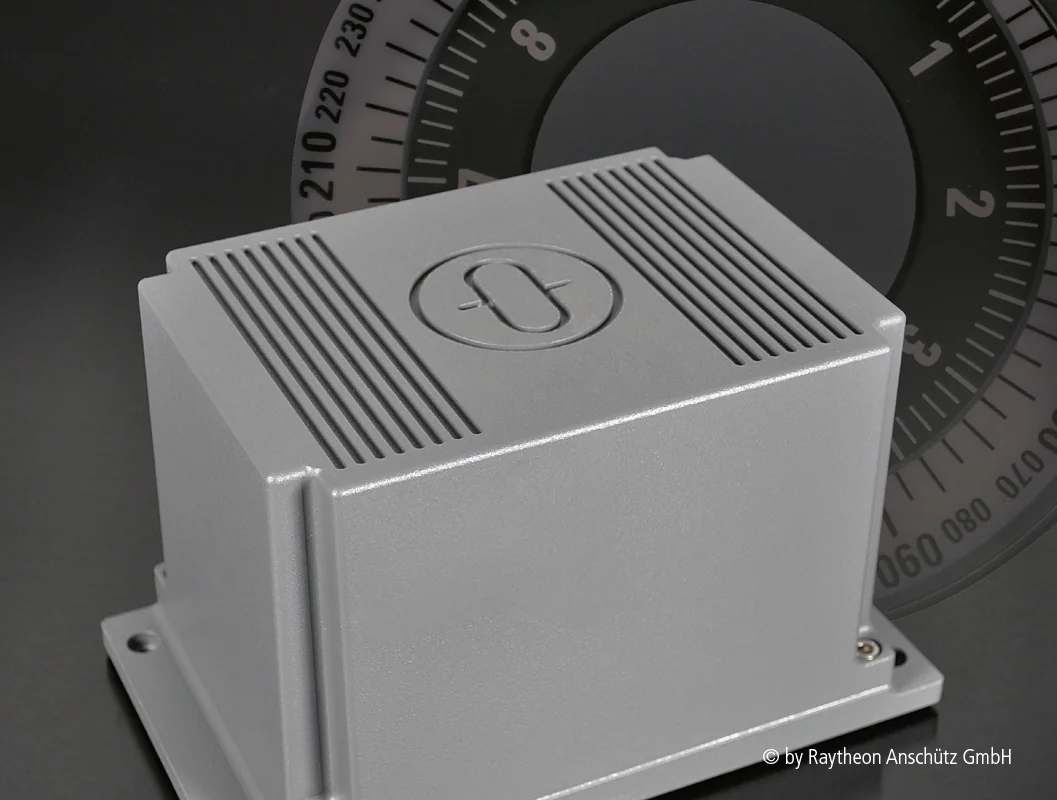
A gyro compass gives true heading independent of the earth's magnetic field, which is why
every substantial vessel carries one. A magnetic compass is deflected by the ship's own steel,
by cargo and by local anomalies, and it points at magnetic north rather than true north. The
gyro does neither, and its output is what feeds the autopilot, the radar's stabilised display,
the ECDIS and the AIS.
Traditional gyro compasses achieve that with a spinning mass, which means bearings, and
bearings mean wear, scheduled overhaul and eventual replacement. The Standard 30 MF instead
uses HRG technology - a resonator gyro with no rotating assembly - and the practical
consequence is the one Anschutz lead with: no wear and tear and no need for maintenance. The
MF in the name stands for maintenance-free, and it is a claim about the total cost of the
instrument over the life of the vessel rather than about its accuracy.
The reliability figure follows from the same design. Anschutz quote MTBF at more than
100,000 hours and note that this is a multiple of the MTBF values of optical gyros - which is
the comparison that matters, since fibre-optic gyros are the usual alternative when moving away
from spinning-mass designs. For a vessel where a compass failure means a voyage interruption,
that is the number to weigh.
On performance, heading accuracy is quoted as 0.25 degrees times the secant of latitude
RMS. The secant-of-latitude term is worth understanding: gyro compass error grows as you move
away from the equator, so the specification is expressed as a formula rather than a single
figure, and the compass is less accurate at high latitude by the nature of the physics. Rate
of turn accuracy is 0.5 degrees per minute plus 5 percent of the indicated rate.
Approval covers more than the basic function. It is IMO approved for standard and for
high-speed craft, and approved for use as a rate-of-turn indicator - which is not a
convenience but a requirement, since SOLAS calls for a rate-of-turn indicator on vessels above
50,000 gross tons. Using the compass to satisfy that requirement removes a separate instrument
from the bridge and a separate approval from the file. Settling time is quoted inconsistently
by different distributors, so we confirm it from the current Anschutz data sheet for the
configuration being supplied rather than repeating a figure here.