Jl. M.H. Thamrin Kav 3, Menara Thamrin, Level 3A, Jakarta 10250 +62-2139-8303-03 / +62 857 6344 7043 contact@vivoasia.com
MSN30-Ex Foghorn
Navigation Equipment

MSN30-Ex Foghorn

Certified foghorn giving 360 degrees of sound over 2 nautical miles, at 134 dB.

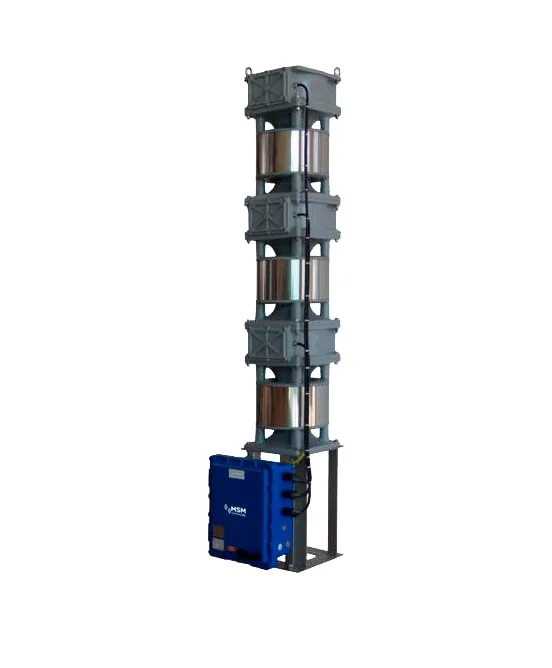
The MSM MSN30-Ex automatically provides a 360 degree beam of sound in the horizontal plane with an audible range over 2 nautical miles. Three stacked emitters give 134 dB at 1 metre, and its II 2G Ex d IIB T5 Gb IP66 rating covers Zone 1 and Zone 2.

  • 360 degrees in the horizontal plane, over 2 nautical miles
  • II 2G Ex d IIB T5 Gb, IP66, for Zone 1 and Zone 2
  • Modular: emitters added or removed to set the sound level
SPECIFICATIONS
Audible range Over 2 nautical miles
Coverage 360 degrees horizontal, 3 stacked emitters
Output 134 dB at 1 metre
Marking II 2G Ex d IIB T5 Gb, IP66
Standards IALA E-109, Guidelines G1162 and G1090

Description

A fog signal is the audible half of a navigation aid. When visibility closes in, lights and even radar marks become unreliable at close range, and a sound signal tells a vessel that something is there and roughly where. On an offshore platform that is not a courtesy - it is part of the installation's obligation to mark itself, and it is why the horn is specified against IALA recommendations rather than chosen for loudness.

The MSN30-Ex produces a 360 degree beam of sound in the horizontal plane, which is the right answer for a structure rather than a shoreline: a vessel could approach from any bearing, so there is no direction to favour. MSM quote an audible range of over 2 nautical miles, achieved by three stacked emitters producing 134 dB at 1 metre. It operates automatically, which in practice means it is triggered by a visibility sensor rather than by someone noticing the fog.

The modular construction is the feature that makes it adaptable. Because the output comes from stacked emitters, the sound intensity can be increased or reduced at will by changing how many are fitted. That matters because the required range is a function of the location and the traffic, and because over-provisioning a fog signal is not harmless - it is a noise source on a manned installation where people work and sleep.

Certification is what allows it on a hydrocarbon facility at all. The horn belongs to ATEX and IECEx Classification Group II, Category 2, marked II 2G Ex d IIB T5 Gb with IP66 ingress protection, which permits use in potentially explosive atmospheres classified as Zone 1 and Zone 2, in gas. The Ex d is a flameproof enclosure. Note the gas group is IIB, which does not cover IIC gases such as hydrogen and acetylene, so the marking has to be checked against the area classification rather than assumed adequate. A junction box of the same d construction is included, which removes the most common gap in an Ex installation.

The signal itself is Morse code letter U or A, and the unit is designed according to IALA Recommendation E-109 and Guidelines G1162 and G1090 - the documents that govern how aids to navigation are specified and characterised. An emergency mode is available as an option, and the unit is built with protection against corrosion, which for a device that lives in salt spray and radiates sound through its own housing is not a small consideration.

Features

  • 360 degrees horizontal. No favoured bearing, which is what a structure approached from any direction needs.
  • Over 2 nautical miles. Audible range from three stacked emitters at 134 dB at 1 metre.
  • Modular output. Emitters added or removed to set sound intensity to the location.
  • Zone 1 and Zone 2 certified. II 2G Ex d IIB T5 Gb, ATEX and IECEx Group II Category 2.
  • IP66 and corrosion protected. Built for permanent exposure to salt spray.
  • Ex d junction box included. Matching enclosure, so the installation is complete and compliant.
  • Morse U or A. Standard identification characters for the signal.
  • IALA compliant. Designed to Recommendation E-109 and Guidelines G1162 and G1090.
  • Automatic operation. Triggered by visibility rather than by an operator.
  • Emergency mode option. Available where required.

Applications

Fog signals mark structures in reduced visibility.

  • Offshore platforms. Where MSM specifically position it, alongside places with thick fog.
  • Offshore wind farms. Marking turbines and substations.
  • Jetties and terminal heads. Marking the structure to approaching vessels.
  • Bridges. Audible marking of piers and spans.
  • LNG terminals. Where classified-area certification is required.
  • Fog-prone coasts. Where the signal is in use often rather than rarely.

Support & Documents

PT Vivo Asia Teknologi Indonesia supplies navigation and nav-aid equipment as part of a designed and commissioned installation. Our scope typically covers:

  • Selection against the applicable IMO, IALA and class requirements for the installation.
  • Siting studies: mounting height, obstruction, sector definition and range.
  • Power and backup design, including solar and battery autonomy where required.
  • Supply, installation, termination and commissioning.
  • Documentation for class, flag or the relevant harbour authority.
  • Periodic inspection, lamp and battery replacement and ongoing maintenance.

Ranges, characters, approvals and electrical details vary by variant and are confirmed against the current manufacturer datasheet at quotation stage. Tell us the structure, the required range and the authority you are reporting to, and we will come back with the right variant and a full bill of materials.

Use the enquiry button above for a datasheet, a specification or a project quotation.

Related products