Jl. M.H. Thamrin Kav 3, Menara Thamrin, Level 3A, Jakarta 10250 +62-2139-8303-03 / +62 857 6344 7043 contact@vivoasia.com
Navigation Equipment

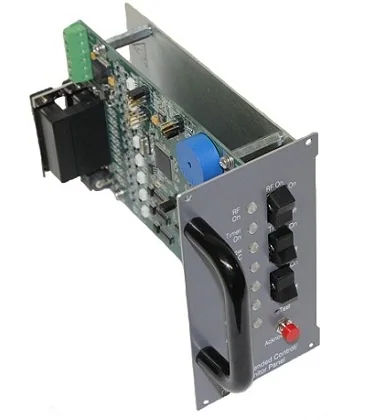
Nautel ECMP3 Extended Control / Monitor Panel

Remote panel for a Vector NDB: LEDs, an audible alarm you can acknowledge, and a test.

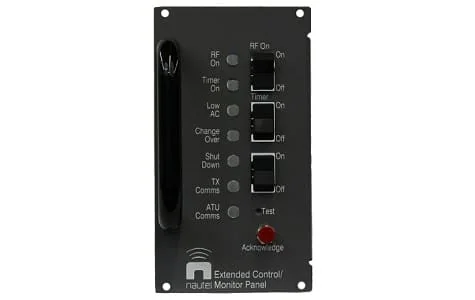
The Nautel ECMP3 is a remote control and monitoring panel for a Vector Series NDB transmitter. It gives visible and audible indication of the transmitter inputs and outputs, with a configurable audible alarm, an acknowledge button, a test feature and timer enable control.

  • Visible and audible indication of transmitter status
  • Configurable audible alarm with acknowledge
  • Up to three external panels via RS-485
SPECIFICATIONS
Function Remote control and monitoring of a Vector NDB
Interface Direct via optional Site Interface board, or VR-Link
Quantity Up to three external plus one internal
Bus RS-485 serial communication
Controls Timer enable, alarm acknowledge, test, brightness and volume

Description

An NDB transmitter is usually in an equipment room and the person who needs to know its state is not. The ECMP3 is the answer to that at its simplest: a panel, somewhere useful, whose LEDs show whether the beacon is healthy and whose sounder says so if it is not.

Nautel are candid about the positioning - it provides economical, basic control and monitoring of a Vector NDB system for situations where more extensive control and monitoring is not required. That honesty is useful. If a site needs graphs, logs and remote configuration, the VR-Link with its browser interface is the right product. If what is needed is for the radio room or the control room to know the beacon is on air, this is cheaper, simpler and has nothing to go wrong.

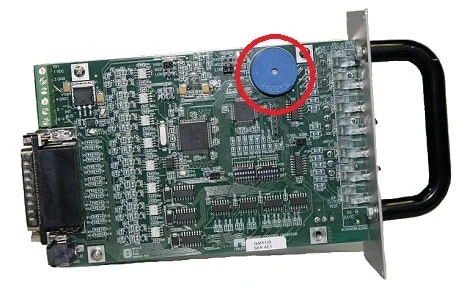
The audible alarm is the part worth configuring properly. It is user configurable to activate from any of the status alarm inputs, either on the input being asserted or on it changing state, and an acknowledge button silences the recurrence. That distinction between asserted and changed state is more useful than it first appears: some conditions matter while they persist, others matter at the moment they happen. Getting that right is what stops a panel being either ignored or silenced permanently - the two ways alarm panels fail in practice.

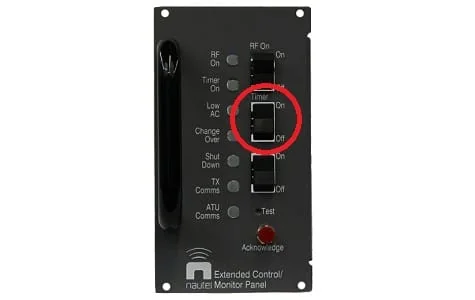
Alongside it there is a timer ON/OFF switch that remotely triggers the programmable operation timer in the Vector transmitter, a test feature, brightness and volume controls, and spare user-configurable control and monitoring channels for whatever else the site wants brought to the panel. Brightness control matters on a bridge or in a darkened control room, where a bright panel is a nuisance rather than an aid.

Connection is either directly to the Vector transmitter through the optional Site Interface board, or via the optional VR-Link remote control and monitoring unit over RS-485 serial communication. Up to three external ECMP3s and one internal panel can be connected to a VR-Link, so the beacon's state can appear in the radio room, the control room and the maintenance workshop at once, which is usually what a site actually wants.

Features

  • Visible and audible. LEDs indicate alarm conditions and a sounder draws attention to them.
  • Configurable alarm logic. Trigger on a status input being asserted or on it changing state - a genuine distinction.
  • Acknowledge button. Silences recurrence without disabling the alarm.
  • Up to four panels. Three external and one internal on a VR-Link, so several locations see the same state.
  • Timer enable control. Remotely triggers the transmitter's programmable operation timer.
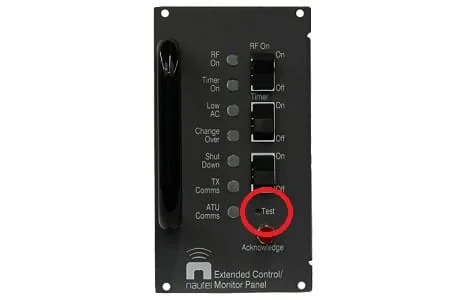
  • Test feature. Confirms the indication path works, rather than assuming it.
  • Brightness and volume control. For darkened control rooms and bridges.
  • Spare channels. User-configurable control and monitoring for site extras.
  • Deliberately basic. Nautel's own framing - economical monitoring where full remote control is not needed.

Applications

Anywhere someone needs to know the beacon is on air.

  • Platform radio rooms. Beacon status where the radio operator sits.
  • Central control rooms. Alongside the other platform alarms.
  • Helideck control positions. Confirming the approach aid before a flight.
  • Maintenance workshops. A third panel for the technicians.
  • Small and simple sites. Where a full remote monitoring system is not justified.
  • Existing Vector installations. Added later to bring status to a new location.

Support & Documents

PT Vivo Asia Teknologi Indonesia supplies navigation and nav-aid equipment as part of a designed and commissioned installation. Our scope typically covers:

  • Selection against the applicable IMO, IALA and class requirements for the installation.
  • Siting studies: mounting height, obstruction, sector definition and range.
  • Power and backup design, including solar and battery autonomy where required.
  • Supply, installation, termination and commissioning.
  • Documentation for class, flag or the relevant harbour authority.
  • Periodic inspection, lamp and battery replacement and ongoing maintenance.

Ranges, characters, approvals and electrical details vary by variant and are confirmed against the current manufacturer datasheet at quotation stage. Tell us the structure, the required range and the authority you are reporting to, and we will come back with the right variant and a full bill of materials.

Use the enquiry button above for a datasheet, a specification or a project quotation.

Related products